Netstal Takes the Elion 3200 Fully Electric for 1.8-Second Closure Moulding
Netstal is taking its Elion platform further into all-electric high-speed packaging, with a new 3,200 kN machine aimed squarely at demanding beverage-closure production.
 By PlasticParts HubPlasticParts Hub
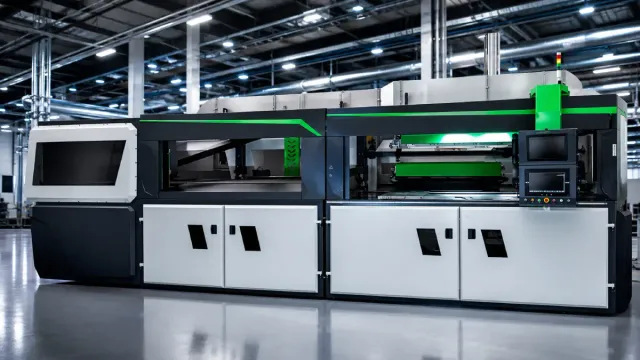
Image source: KraussMaffei AHEAD archive. Illustrative Elion 3200-2000 platform image; the Fakuma 2026 Elion 3200 CAP is a new all-electric configuration.
Netstal is bringing a fully electric Elion into a part of the injection moulding market where speed has traditionally made hybrid drive concepts difficult to displace.
The Swiss machine builder says its new Elion 3200 CAP will make its public debut at Fakuma 2026 in October. The machine combines a newly developed 3,200 kN electric clamping unit with the new electric injection unit 2000. In the trade-fair cell, it will mould 26 mm HDPE beverage closures in a 72-cavity tool at a stated cycle time of 1.8 seconds.
The 1.8-second cycle will get most of the attention at the show. More revealing is the application Netstal has chosen for the launch: a high-output closure line where injection dynamics, screw recovery and machine availability leave little room for compromise.
The demonstration brings together Z-MOULDS, MHT, TotalEnergies, Piovan, IMDvista and ef cooling. The mould has 72 cavities, the shot weight is 72 g, and the downstream package includes cooling, handling and optical inspection. It is therefore better read as a production cell than as a machine-only demonstration.
Why closures are a hard test for an all-electric machine
A beverage closure is small, but closure production is not a light-duty injection moulding job. Multi-cavity tools put a premium on repeatability because a small imbalance multiplied across dozens of cavities can quickly become a quality or scrap problem. At the same time, the business depends on very short cycles and high annual output.
A machine has to inject quickly, switch accurately from filling to holding pressure, recover for the next shot and open and close the mould with very little non-productive time. The clamp also has to remain stiff enough for the mould to behave consistently over millions of cycles.
Viewed in that context, the 1.8-second figure is less useful as a record and more useful as a marker of where Netstal wants the all-electric Elion to operate. The company is not restricting the concept to slower technical moulding. It is putting the machine into a closure cell that exposes weaknesses in acceleration, control and thermal management almost immediately.
The stated 72 g shot also gives useful context. At 72 cavities, the average material allocation is roughly one gram per closure before considering runner details. Small shot-to-shot deviations can therefore matter at the part level.
A new clamping unit built around short dry cycles
Netstal says the revised toggle geometry is designed to shorten dry-cycle time. The force path through the clamping unit has also been reworked to increase platen rigidity and support service life.
For a closure producer, these are production changes rather than cosmetic updates. The mould-open portion of the cycle is dead time unless it is needed for part removal or other downstream work. Faster movement only helps, however, if platen guidance, mould protection and mechanical loads remain under control.
The company has also paid attention to maintenance access. The protective covers use smooth surfaces intended to be easier to clean, and automatic grease lubrication is available as an option for linear guides and ejector guidance. The ejector itself can be specified as electric or hydraulic.
None of those features will attract the same attention as cycle time, but they are the kind of details that influence uptime in a plant running around the clock.
Electric injection unit 2000 is the other half of the story
The machine's new electric injection unit 2000 has a 260 mm screw stroke. Depending on screw diameter, Netstal lists maximum injection pressure of up to 2,400 bar.
The unit uses synchronously controlled injection spindles, an arrangement intended to distribute mechanical load symmetrically. Netstal also retains its force-dependent pressure switchover approach, which the company uses to separate the transfer point from variations in material behaviour.
For closure moulding, this is particularly relevant. A fast filling stage is only useful if the machine can hit the transfer point consistently. Moving too early can produce short or under-packed parts; moving too late can produce flash, excessive cavity pressure or unnecessary clamp loading.
A 72-cavity system makes those deviations expensive because a bad shot is not one rejected part. It is a complete moulding cycle of 72 parts.
Energy efficiency is now being argued at packaging speeds
The common case for all-electric injection moulding is straightforward: servo drives only consume significant power when axes are moving, and energy is not continually converted through a hydraulic system. The harder question is whether an electric platform can preserve those benefits while meeting the dynamics of high-speed packaging.
Netstal says the Elion 3200 CAP combines electric injection with high-efficiency servo drives and an optimised power-supply architecture. The company claims intelligent load distribution and the revised feed-in concept can deliver additional energy savings of up to five percent.
That number should be treated as a configuration-specific manufacturer claim rather than a universal plant saving. Actual consumption depends on cycle, resin, mould, auxiliary equipment, cooling and production rate. A fair comparison also needs to be made in energy per good part, not simply machine power draw.
The closure cell is nevertheless a useful benchmark because productivity is built into the comparison. If an all-electric machine only saved energy by running slower, the business case would be weak. Netstal is explicitly trying to show that the two objectives can coexist.
The machine is becoming one component of the control architecture
The Elion 3200 CAP uses Netstal's Axos 9 control system. The interface combines touchscreens with physical controls, while the Smart Operation function can guide operators through predefined sequences.
More important for an integrated cell, the machine supports OPC UA interfaces and HTML5 integration. That allows peripherals and higher-level production systems to exchange information with the injection moulding machine rather than operating as isolated islands.
In a closure line, this matters because the moulding machine is only one source of production data. Material preparation, cooling, vision inspection and downstream handling all influence whether the line is producing saleable product.
A useful future development would be tighter correlation between those data streams: cavity-related process behaviour from the machine, reject patterns from the vision system and environmental or material-handling information from the peripherals. Netstal's announcement does not claim that level of analytics, but the communications architecture makes deeper integration possible.
Netstal is not abandoning hybrid machines
One point in the announcement is easy to overlook. Netstal is not presenting the new machine as proof that hydraulic or hybrid injection moulding is obsolete.
The company says electric and hybrid drive concepts will continue side by side. Within the new Elion platform, the intended clamping-force range from 2,200 to 4,200 kN will be available in all-electric or hybrid configurations, with the application determining the choice.
That is a more credible position than treating one drive architecture as universally superior. High injection power, material behaviour, investment cost, service requirements and energy prices can all change the economic answer.
Netstal has already introduced 1,200 and 1,750 kN clamping units and electric injection units 270 and 530 on the new platform. The 3,200 and 4,200 kN clamping units and injection unit 2000 extend the concept upward. A 2,200 kN clamp and injection unit 940 are planned for summer 2027.
The result is a modular product strategy rather than a one-off Fakuma machine.
What moulders should look for at Fakuma
The key question at the show will not be whether the machine can complete a 1.8-second demonstration cycle. Netstal has already published that target. The useful questions are how stable the cell remains over a long run and what trade-offs sit behind the number.
Processors evaluating the platform should look at:
- actual energy consumption per 1,000 accepted closures;
- shot-weight and dimensional variation over time;
- reject distribution across the 72 cavities;
- mould-open and ejector timing;
- screw recovery margin at the stated cycle;
- cooling demand and the contribution of the peripheral equipment;
- maintenance access around the production cell;
- how much of the setup can be stored, transferred and reproduced through the control system.
Those are the measures that turn a trade-fair demonstration into a production decision.
Why the launch matters beyond the exhibition booth
All-electric injection moulding has been expanding for years, but not every application has moved at the same pace. High-speed packaging and closures remain demanding because output per hour is unforgiving and the machine has little time to recover from any instability.
The Elion 3200 CAP is notable because Netstal is choosing that demanding segment as the public test for its larger all-electric platform.
If the production cell can combine the stated 1.8-second cycle with the shot consistency, uptime and energy performance expected by closure producers, the launch will strengthen the case for electric drives in applications that were once assumed to favour hybrid systems by default.
Fakuma will provide the first public look. The more important verdict will come later, when machines with the same architecture run normal production shifts rather than exhibition hours.
Sources
- Fakuma — Premiere at Fakuma: Netstal presents all-electric Elion for closure production — August 19, 2026.
- Plastech — Netstal debuts all-electric Elion 3200 CAP at Fakuma — August 19, 2026.
- Netstal — Technical data Elion electric — technical reference, 2026.
- KraussMaffei AHEAD — From steam locomotives to Plastics 4.0 — image reference for the Elion 3200-2000 platform.
Editorial note: This is an original industry analysis based on the sources above, not a translation or reproduction of Netstal's announcement.
Publishing note: The image is an illustrative archive image of the Elion 3200-2000 platform. Confirm reuse rights with the image owner before publication on an external website.